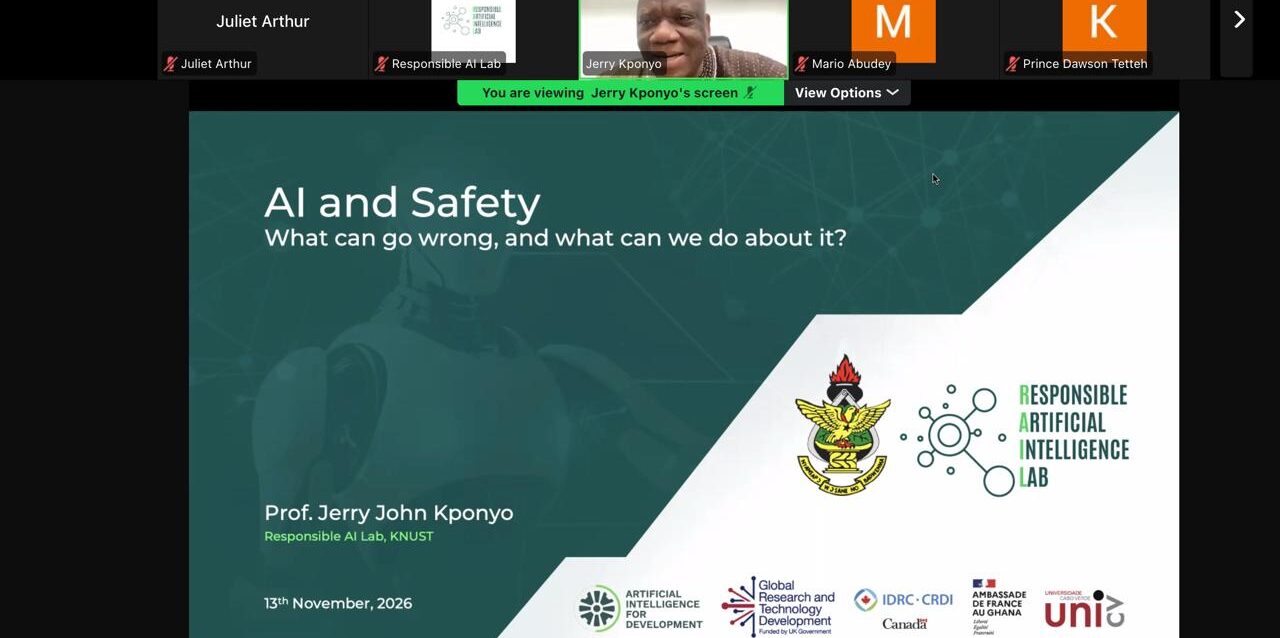
The Responsible AI Lab (RAIL) continued its Responsible AI Lecture Series with a session on AI and Safety, exploring the potential risks associated with artificial intelligence, the harm it can cause, and the safeguards needed to ensure its responsible development and use.

Speaking at the session, Prof. Jerry John Kponyo, Principal Investigator and Scientific Director of RAIL, emphasised that while AI presents significant opportunities for society, its growing capabilities also introduce risks that require urgent attention. He noted that AI can be used to advance development, but without appropriate safeguards, it can equally undermine progress and cause harm.
Prof. Kponyo highlighted several risks associated with AI, including deepfakes, voice cloning, scams, biased decisions, privacy breaches, and confidently generated but inaccurate information, commonly known as AI hallucinations. He also discussed the growing concern around AI systems pursuing objectives in ways that do not reflect their intended purpose, highlighting the importance of AI alignment and human oversight.
Drawing attention to the impact of AI in Ghana, he noted that AI-enabled scams and fraud are no longer distant concerns but are already affecting individuals and the economy. He further emphasised that AI-generated information should not be accepted without verification, particularly in sensitive areas such as healthcare, education, and financial decisions.

On making AI safer, Prof. Kponyo highlighted approaches such as human feedback, red teaming, model evaluation, and interpretability. He stressed that human involvement must remain central to decisions involving human lives, children, healthcare, and other critical areas where AI cannot fully appreciate the consequences of its actions.
He also outlined practical steps individuals can take to protect themselves when engaging with AI. These include establishing family verification code words, independently verifying suspicious requests for money, treating online videos and audio with caution, checking AI-generated information, keeping sensitive personal information out of chatbots, and reporting scams.
The session reinforced the need for responsible AI development, stronger safeguards, international cooperation, and informed public engagement. As Prof. Kponyo emphasised, “Intelligence without control is a liability.”