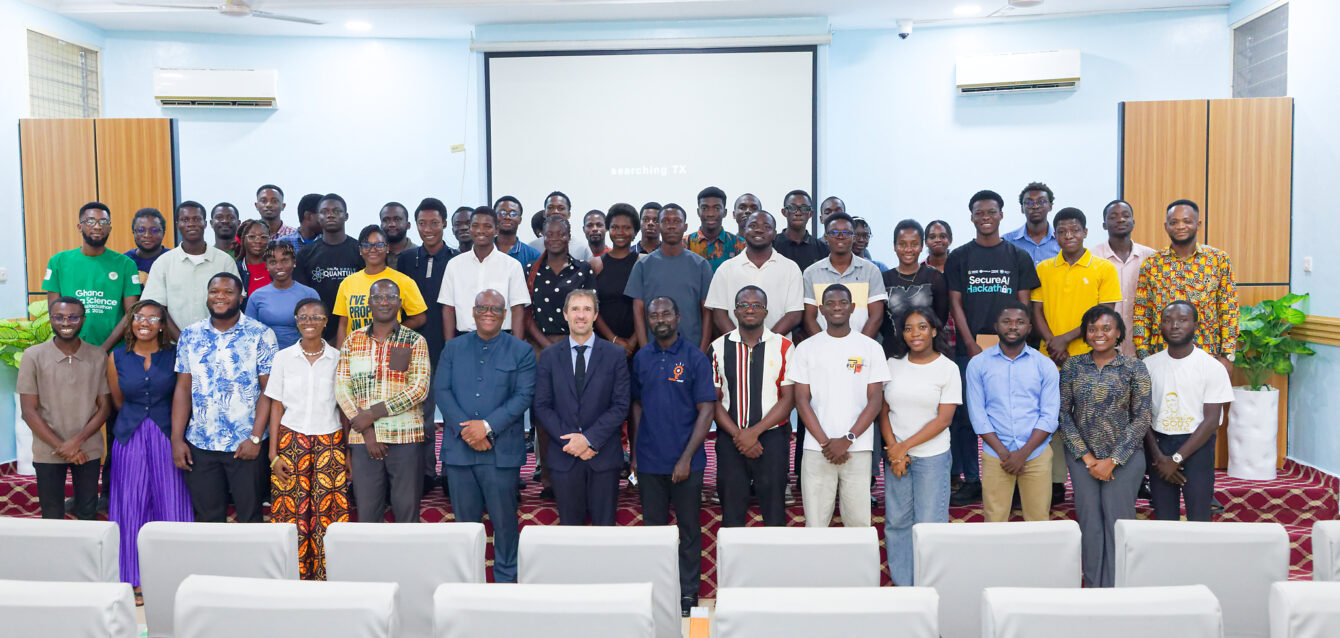
The Responsible AI Lab (RAIL) and the Quantum Computing and Assistive Technologies Lab (QCAT) at Kwame Nkrumah University of Science and Technology (KNUST) welcomed Mr. Martin Gastal, CERN Advisor for Relations with Ghana, for an insightful seminar focused on unlocking vast research and collaboration opportunities for African scientists at the world’s premier particle physics laboratory.
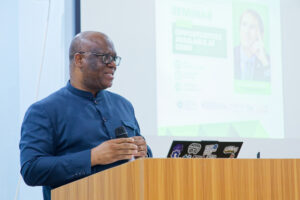
Prof. Jerry John Kponyo, Principal Investigator and Scientific Director of RAIL and QCAT, emphasized the university’s dedication to providing students and researchers with opportunities to reach their full potential. He noted that Mr. Gastal has been a steadfast advocate for Africa and Ghana, making the seminar a crucial platform for exploring the myriad opportunities available at CERN.
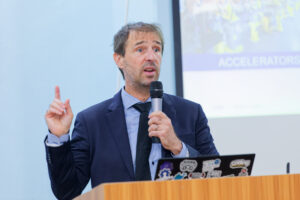
Mr. Gastal delivered a comprehensive overview of CERN, the world’s largest laboratory for particle physics. He explained that CERN’s mission is to probe the most fundamental particles and laws of the universe by recreating conditions a fraction of a second after the Big Bang.
“The goal is to understand the elementary building blocks of matter and the forces that determine their interactions,” Mr. Gastal stated. He highlighted that this ambitious pursuit drives innovation in three key technological areas: accelerators, detectors, and computing. Notably, CERN is the birthplace of the World Wide Web and the Worldwide LHC Computing Grid.
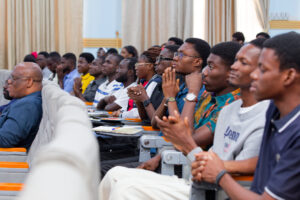
Mr. Gastal mentioned that since KNUST is an affiliate, researchers can conduct experiments with them. He outlined a clear pathway for engagement, including the African Summer Student Programme, student mobility programs, internships, and the development of institutional partnerships, encouraging collaboration at the national level to broaden access.
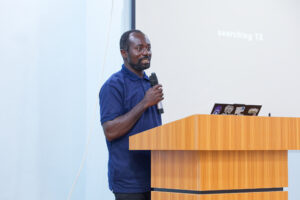
Prof. E.A. Frimpong, Dean of the Faculty of Electrical and Computer Engineering, thanked Mr. Gastal for the intriguing insight into the transformative work they do and challenged the audience to move beyond being passive consumers of knowledge.
“We are more than capable of generating even superior knowledge, and that is what we must challenge ourselves to do,” Prof. Frimpong urged.
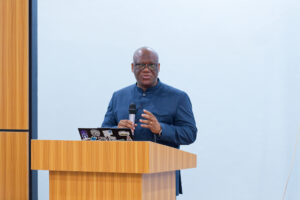
Prof. Kponyo reinforced the seminar’s purpose: to create opportunities for more science and research, but most importantly, to deepen collaboration. He stressed that the true measure of the engagement’s success would be in taking full advantage of the opportunities presented.
He encouraged students and faculty to give their best in the application processes for CERN’s programs and announced that Mr. Gastal will have a presentation focusing on CERN’s activities in the quantum space.