
The Responsible AI Lab (RAIL) participated in the Digital Futures Symposium in Cape Town, South Africa, to explore how AI infrastructure impacts power and sovereignty on the African continent. RAIL was represented by MPhil research assistant Dickson Marfo Fosu, who combined a technical site visit with a lightning talk on how to think more concretely about AI infrastructural sovereignty in Africa.
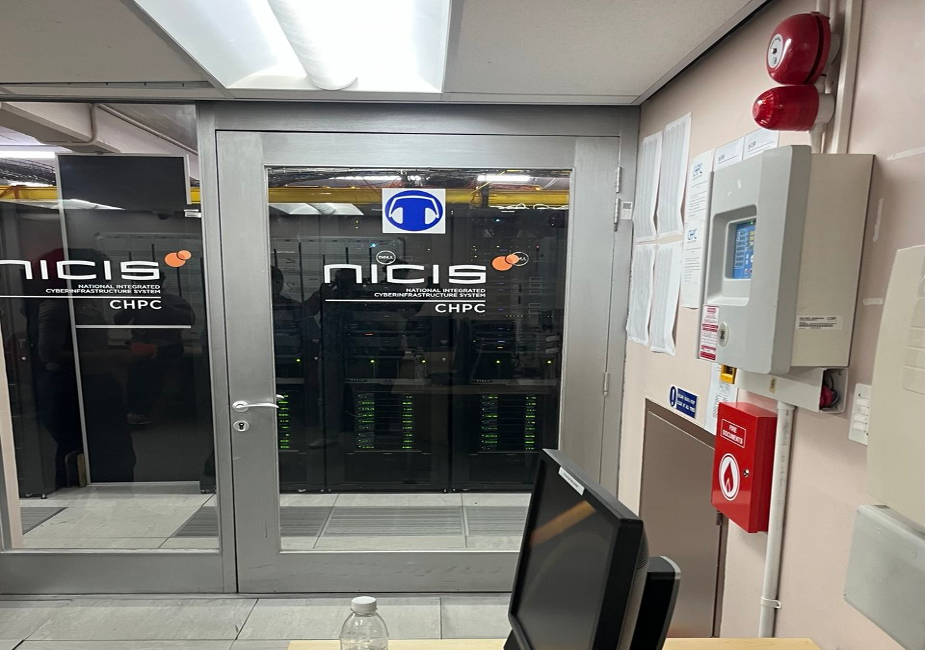
A key moment of the visit was a tour of the Centre for High Performance Computing (CHPC), managed by the Council for Scientific and Industrial Research (CSIR) in Cape Town. Walking through the facility, participants encountered the physical reality behind AI: racks of servers, cooling systems, energy management and the routines that keep large-scale computing available and secure. For Dickson, the CHPC visit underscored that questions of AI sovereignty are not abstract. They begin with who owns, funds, and governs compute infrastructure; how access is granted to researchers and institutions across the continent; and whether such facilities enable African actors to experiment, innovate, and negotiate with greater confidence, rather than deepening their dependence on foreign cloud providers.
At the Symposium itself, Dickson delivered a lightning talk proposing a five-part lens for measuring AI infrastructural sovereignty in African countries. Instead of treating sovereignty as a loose slogan, the framework looks at how ownership and control of compute infrastructure, patterns of data movement, dependence on foreign AI models and platforms, exposure to external legal jurisdictions, and the institutional capacity of states and public bodies all interact to shape a country’s real room for manoeuvre. In simplified terms, it asks who runs the machines, where the data travels, whose tools are being used, which laws can reach into those systems, and whether public institutions are equipped to bargain and regulate effectively.
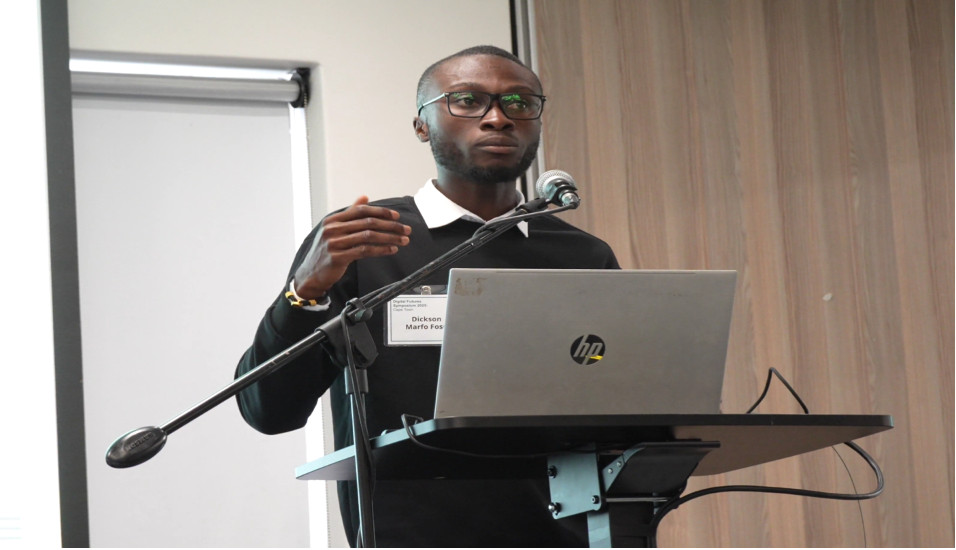
The talk prompted a lively discussion about whether any country can ever be fully sovereign in a deeply interconnected AI ecosystem, or whether sovereignty is better understood as a spectrum of dependence and autonomy that shifts over time. By connecting the concrete experience of standing inside the CHPC with this analytical lens, Dickson’s contribution helped situate African concerns at the centre of debates about AI infrastructure and power.
Through this engagement in Cape Town, RAIL deepened its work on AI infrastructural sovereignty, linking material infrastructure to law, politics and capacity, and opening up new avenues for research, collaboration and policy engagement across the continent.